When growth slows, marketing is often the first place B2B companies look for answers.
- “We need more leads.”
- “We need better content.”
- “We need to improve our website.”
- “We should be more active on LinkedIn.”
- “Maybe we need paid campaigns.”
- “We need stronger sales outreach.”
Each of these may be perfectly reasonable.
But there is a more fundamental question that rarely gets asked:
What is the core value that all of this activity is supposed to amplify?
For many B2B companies, the problem isn't a lack of marketing activity.
It isn't even necessarily a lack of marketing capability.
It is a lack of focus around a clear Value Driver.
Without that Value Driver, marketing becomes a collection of campaigns, sales becomes a collection of conversations, and growth becomes a collection of opportunities.
There is plenty of activity.
But there is no thread connecting it all.
The Missing Thread in B2B Growth
Look at the marketing and sales activity inside a typical B2B company.
The website talks about one set of capabilities.
Sales presentations emphasise another.
LinkedIn posts follow whatever topic happens to be relevant that week.
Campaigns promote individual products or services.
Case studies tell isolated customer stories.
Salespeople adapt the proposition according to whichever prospect they are speaking with.
Then leadership introduces another solution, enters another market or identifies another growth opportunity.
Individually, none of these things is necessarily wrong.
The problem is that they often don't reinforce one another.
There is no central idea accumulating value across all of them.
That central idea is what I call the Value Driver.
What Is a Value Driver?
A Value Driver is the core source of business value that connects what your company does with what your customers are ultimately trying to achieve.
It sits underneath your products, services, capabilities and marketing messages.
It answers a deeper question than:
“What do we sell?”
It answers:
“What value are we exceptionally good at creating?”
For one company, the Value Driver might be reducing operational complexity.
For another, it might be accelerating time-to-market.
For another, it could be increasing asset utilisation, reducing business risk, improving decision-making or creating visibility across fragmented operations.
Your products may change.
Your services may expand.
Your campaigns will certainly change.
But the underlying Value Driver can remain remarkably consistent.
And that consistency creates something extremely important:
a strategic thread running through the business.
Your Value Driver Is Bigger Than Your Value Proposition
These two ideas are easy to confuse.
A value proposition usually explains why a customer should choose a particular product, service or company.
A Value Driver goes deeper.
It identifies the fundamental value your organisation is built to create.
Think of it this way:
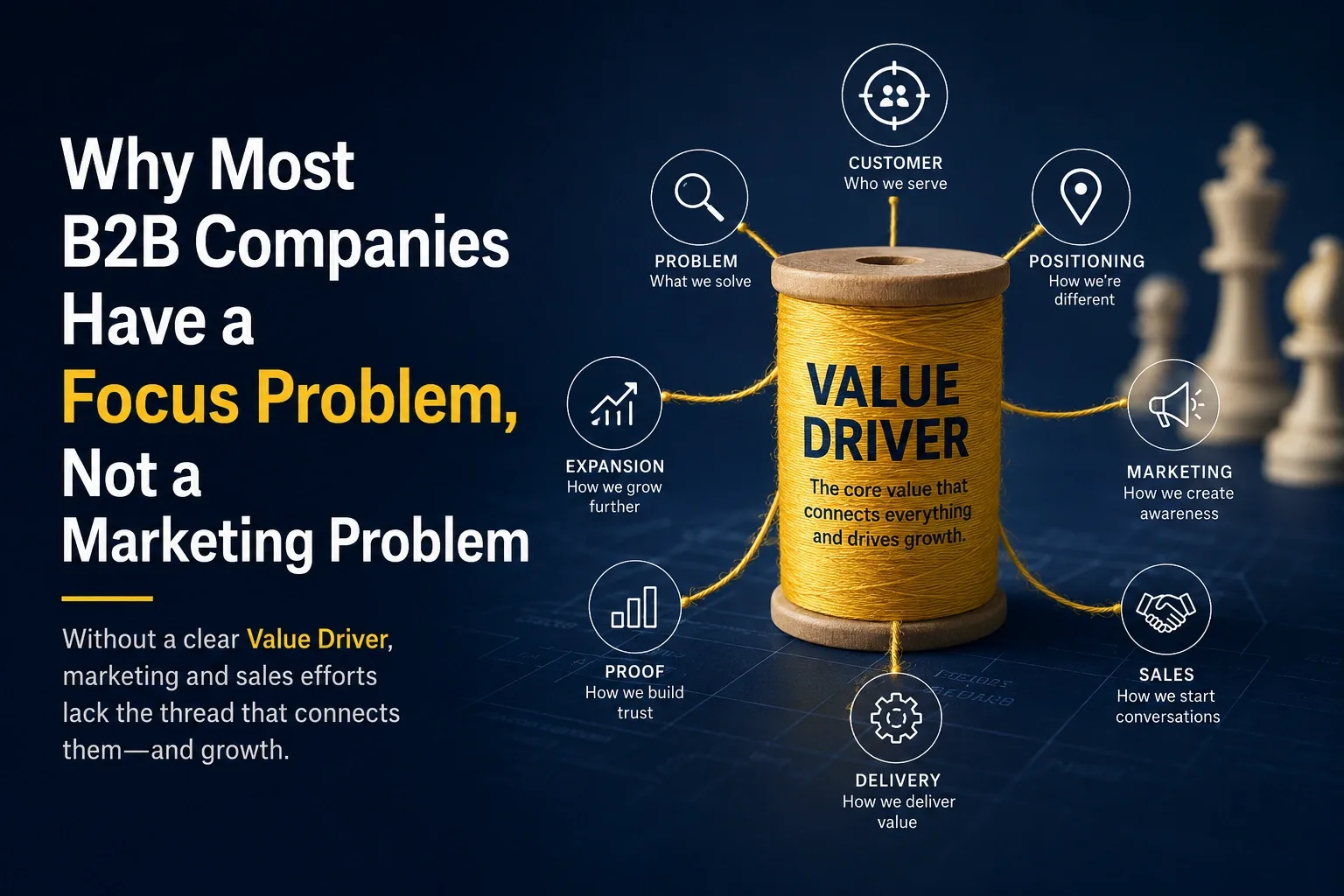
Value Driver → Market Position → Value Proposition → Marketing → Sales → Customer Outcomes → Growth
The Value Driver sits upstream.
Everything else should flow from it.
That is why identifying it can have such a powerful effect on marketing focus.
Instead of asking every campaign to invent a new reason for customers to care, the organisation begins reinforcing the same fundamental source of value from different angles.
The Activity Trap
When companies don't have this clarity, they often compensate with activity.
- Pipeline is weak?
- Generate more leads.
- Website traffic is low?
- Invest in SEO.
- Engagement is falling?
- Publish more content.
- Sales needs support?
- Create more collateral.
- Competitors are getting attention?
- Launch another campaign.
Activity feels like progress because activity is visible and measurable.
But adding more activity to an unfocused growth system often creates more fragmentation.
Imagine a B2B company targeting five industries, four buyer personas and multiple company sizes.
It offers several solutions, each marketed differently.
The website tries to accommodate all of them.
Content jumps between topics.
Salespeople tell different versions of the company story.
Campaigns promote different capabilities.
The company may be extremely busy.
But the market struggles to answer a very simple question:
“Why does this company matter?”
Focus Is Not Simply About Doing Less
This is an important distinction.
Focus doesn't mean choosing one marketing channel.
It doesn't necessarily mean selling one product.
It doesn't even mean serving only one industry.
Real strategic focus comes from knowing what everything connects back to.
A company may have several products.
It may operate across multiple industries.
It may use ten marketing channels.
But if all of those activities reinforce a recognisable Value Driver, they can collectively strengthen the company's market position.
Without that connection, every new initiative starts almost from zero.
With it, every initiative contributes to something larger.
That is the difference between marketing activity and marketing accumulation.
A Value Driver Creates Marketing Accumulation
Consider what happens when a company consistently builds around one core Value Driver.
- Its website explains the problem.
- Its thought leadership explores the implications.
- Its research quantifies the opportunity.
- Its customer stories demonstrate the outcome.
- Its sales presentations show how the company delivers it.
- Its product messaging connects capabilities to it.
- Its executives speak about it.
- Its salespeople diagnose customer problems through it.
Over time, the market begins associating the company with that particular source of value.
Now every piece of marketing is doing two jobs.
It is supporting the immediate campaign.
But it is also reinforcing the company's long-term market position.
Marketing starts to compound.
That is extremely difficult to achieve when every campaign tells a different story.
Your TAM Is Not Your Growth Strategy
Another common source of lost focus is confusing the market you can serve with the market you should actively pursue.
A technology company may be capable of serving manufacturing, healthcare, financial services, logistics, retail and professional services.
That doesn't mean it should market equally to all six.
The same applies to products.
Just because your company has twelve capabilities doesn't mean all twelve should receive equal marketing attention.
- Your total addressable market tells you where opportunity may exist.
- Your growth strategy determines where you will concentrate resources.
- Your Value Driver provides the logic connecting those choices.
This gives leadership a much stronger filter for evaluating opportunities:
- Does this market allow us to create our core value particularly well?
- Does this product strengthen our ability to deliver that value?
- Does this campaign reinforce what we want to become known for?
- Does this opportunity take us closer to our strategic position—or simply create revenue?
Those are very different questions.
The Cost of Being Known for Too Many Things
Many B2B companies are reluctant to narrow their message.
They worry that focus means excluding opportunities.
So they describe themselves broadly.
The result is often language such as:
“We provide innovative end-to-end solutions that help organisations transform, improve efficiency and achieve sustainable growth.”
Nothing is technically wrong with it.
But very little is memorable about it.
The market doesn't remember lists of capabilities particularly well.
It remembers associations.
A company becomes associated with security.
- Or speed.
- Or simplicity.
- Or reliability.
- Or operational efficiency.
- Or a particular business problem.
The stronger that association becomes, the easier it becomes for customers to understand where the company fits.
The objective isn't necessarily to do only one thing.
It is to become known for creating a particular kind of value.
The Value Driver Solves the Content Problem Too
Many B2B marketing teams struggle with a recurring question:
“What should we talk about?”
That question becomes much easier once the Value Driver is clear.
Instead of constantly searching for topics, marketing can build a body of thinking around the company's core source of value.
If your Value Driver is reducing operational complexity, for example, you can explore:
Why complexity grows.
- Where complexity creates hidden costs.
- How it affects productivity.
- How it slows decision-making.
- How organisations measure it.
- How technology can reduce it.
- How customers have solved it.
- What executives misunderstand about it.
- Where the problem is heading.
One Value Driver can generate years of meaningful thought leadership.
More importantly, those pieces reinforce one another.
You aren't simply producing content.
You are building intellectual territory around the value you want to own.
It Gives Sales a Stronger Story
The same principle applies to sales.
Without a common Value Driver, sales conversations easily become product-led.
- “We have this capability.”
- “We offer this feature.”
- “We provide this service.”
- “Our platform can do this.”
With a clear Value Driver, the conversation can start with the customer's business.
- What is preventing them from creating the desired value?
- What is it costing them?
- Why does the problem exist?
- What needs to change?
How does your organisation enable that change?
Products and capabilities still matter.
But they become evidence of how you create value, rather than the story itself.
That creates a much stronger connection between marketing and sales.
- Marketing creates understanding of the problem and the value opportunity.
- Sales translates that value into the customer's specific context.
- Delivery proves it.
- Customer success expands it.
- And customer evidence feeds back into marketing.
The same thread runs through the entire commercial system.
The Value Driver Should Also Point Towards Future Growth
Perhaps the most important characteristic of a strong Value Driver is that it shouldn't only explain your business today.
It should create room for the business you want to become tomorrow.
- Products evolve.
- Markets change.
- Technologies change.
- Customer expectations change.
A company defined entirely by its current product can eventually become trapped by that definition.
A company organised around the value it creates has more room to evolve.
If customers associate you with solving a meaningful business problem rather than simply providing a particular product, you can introduce new services, technologies and solutions that extend that value.
That makes the Value Driver not only a marketing concept.
It becomes a growth platform.
It helps answer:
- Where should we expand?
- What capabilities should we build?
- Which products belong in our portfolio?
- Which markets should we enter?
- What acquisitions might make sense?
- Which partnerships strengthen our position?
Future growth becomes an extension of the same strategic logic rather than a collection of disconnected bets.
This Is Why Focus Is a CEO Problem
Marketing teams can sharpen messaging.
- They can improve campaigns.
- They can optimise channels.
- They can generate demand.
But they cannot independently decide what the company fundamentally wants to stand for.
That requires leadership.
Because the Value Driver ultimately sits at the intersection of:
Customer need + company capability + competitive differentiation + economic value + future opportunity.
Finding that intersection is a strategic decision.
If leadership hasn't made it, marketing will inevitably try to compensate.
And the symptoms will appear everywhere.
- Messaging feels generic.
- Content feels disconnected.
- Campaigns don't build on one another.
- Sales tells inconsistent stories.
- New products create new propositions.
- Every growth initiative requires another marketing narrative.
Eventually, the company concludes that marketing isn't working.
But marketing may simply be reflecting a deeper strategic problem.
Build the Growth Plan Around the Value Driver
Before deciding what marketing needs to do next year, start somewhere else.
Ask:
What is the core value our company is uniquely positioned to create?
Then build outward.
- Define the customers for whom that value matters most.
- Identify the business problems that prevent them from achieving it.
- Determine the capabilities that enable you to solve those problems.
- Build your positioning around that value.
- Create marketing themes that reinforce it.
- Give sales a commercial story built around it.
- Develop proof showing that you can deliver it.
Choose channels capable of reaching the customers who care about it.
And evaluate future growth opportunities according to whether they strengthen or dilute it.
The result is no longer simply a marketing plan.
It is a focused growth plan.
And everything has a thread connecting it.
Value Driver → Customer → Problem → Positioning → Marketing → Sales → Delivery → Proof → Expansion
That thread creates coherence.
Coherence creates recognition.
Recognition creates trust.
And trust makes growth easier.
Before You Fix Your Marketing, Find Your Value Driver
When marketing isn't delivering the expected results, the natural response is to examine the visible symptoms.
- Traffic.
- Leads.
- Conversion rates.
- Content.
- Campaign performance.
- Brand awareness.
- Sales pipeline.
Those things matter.
But there is a question worth asking first:
What is the Value Driver connecting everything we are doing?
If there isn't a clear answer, adding another campaign, channel or sales initiative may only add another disconnected activity.
Find the value you are built to create.
Identify the customers for whom that value matters most.
Build your positioning around it.
Make it the thread connecting marketing and sales.
Use it as a filter for future growth.
Then execute relentlessly around that focus.
Because the strongest B2B companies aren't simply good at marketing what they sell.
They understand the value they exist to create—and build their entire growth engine around it.
Thanks
Chandra S Joshi
Fractional CMO
Need a Marketing Strategy?
A short conversation is usually enough to know whether a Strategy Sprint, a Go-to-Market plan, or ongoing Fractional CMO Advisory is the right starting point.
Book a Conversation →